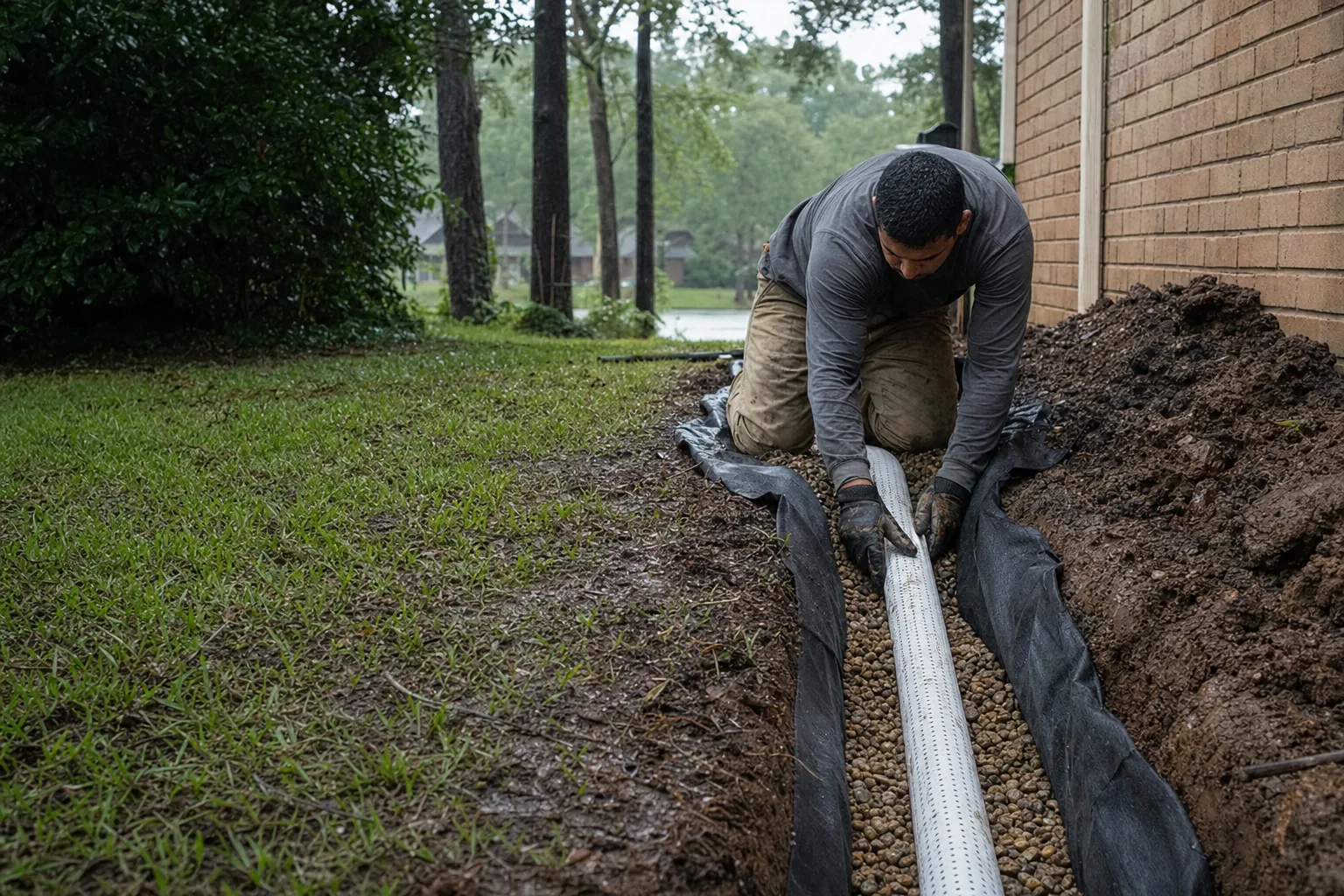
A trench full of rock is easy to picture. The harder question is where the water goes after it enters the trench. A French drain can receive water and carry it along a route. It does not make the water disappear, create fall where none exists, or turn an unsuitable discharge point into a good one.
Texas A&M AgriLife describes the basic idea as a coarse-stone trench leading from a poorly drained area to a lower elevation. That description is useful because it puts the destination in the same sentence as the drain. It is not a universal plan for every Houston yard.
Start with the water, not the product
A French drain is usually discussed as a response to a wet strip of ground. The wet strip is only the symptom. Before choosing a system, watch what happens during rain.
Water running over the grass from a downspout, patio, driveway, or neighboring grade is a surface-flow problem first. Water that appears along a repeatable line as the soil saturates may point toward subsurface collection. A buried break, irrigation leak, air-conditioning discharge, or low spot can resemble either one. If the source is not clear, digging a trench may simply intercept some water while leaving the main cause in place.
Settle the outlet before the trench
The proposed route needs a destination with enough fall to work and a discharge point that fits the address. That check belongs at the beginning, not after excavation starts.
Ask where the line would end, how water would leave that point, and what happens there during a hard rain. An outlet that is already submerged, blocked, too high, or pointed toward another private property can defeat the plan. City guidance generally protects adjacent private property from redirected sheet flow, but the rules and approvals for a particular route still need to be confirmed.
When gravity is not available, adding a pump changes the system. It introduces power, controls, a discharge cycle, and maintenance. That may be reasonable in some places, but it should be an explicit design decision rather than a surprise discovered after the trench is open.
What should be proved before digging
A useful site plan should answer more than where the decorative rock will show.
- Source: What water is the drain expected to receive, and when does it arrive?
- Route: Do measured elevations support movement toward the proposed outlet?
- Discharge: Is the endpoint workable during the same storm that creates the problem?
- Conflicts: Will excavation cross roots, paving, irrigation, utilities, an easement, or a structural edge?
- Service: Where can sediment be observed or cleared later, and what part of the line can be reached if performance changes?
- Restoration: What lawn, planting, edging, or hardscape must be removed and put back?
Texas811 says homeowners and excavators must contact 811 two business days, excluding weekends and holidays, before digging. Utility markings are a safety step, not proof that every private line has been found or that the drainage route is approved.
What changes the cost
There is no responsible single price for a French drain without a route and an outlet. Length matters, but it is only one part of the work. Excavation access, soil handling, roots, paving, utility conflicts, outlet construction, pump requirements, cleanouts, and surface restoration can change the job substantially.
Two proposals with the same number of feet may describe different systems. Compare what each proposal says about the water source, elevations, materials, endpoint, access for service, restoration, and exclusions. A lower number is not a bargain if the outlet is vague. A higher number is not proof of a better design. The reasoning needs to be visible.
Three site conditions feed into that.
- Length and depth grow together. A drain works only while it keeps falling, so a longer run finishes deeper than it started. Excavation grows faster than the tape measure suggests.
- The soil is slow. Texas A&M AgriLife lists saturated hydraulic conductivity for clay at 0.02 inches per hour against 8.27 for sand. Water leaving the trench has nowhere quick to go.
- The ground is flat. USDA NRCS describes the Lake Charles clay series, extensive in southeast Texas, as very slowly permeable with slopes mainly under 1 percent, taking water in rapidly when cracked and very slowly once wet and the cracks close. Finding fall on a flat lot is the hard part of the design.
One national pricing index itemizes permits, inspection costs and landscape repair as factors separate from its base installation figure. Those are the three to ask about when two proposals look close.
High & Dry does not quote and does not price work. We connect you with a local drainage contractor who can put a figure on your property after seeing it.
When a different approach fits better
If roof water is the main source, correcting the downspout route may remove more water before it reaches the yard. If runoff stays on the surface and collects at one hard low point, a surface inlet and solid conveyance line may be more direct. If the grade itself traps water, selective grading may restore a surface path. If no acceptable gravity outlet exists, the decision may involve a pump, storage, a different route, or a smaller source-control project.
These approaches can be combined, but more components do not automatically make a better system. Each piece should have a named job.
Bring a rain record to the inspection
During the next useful rain, take photos from the same few positions. Note when the wet area first appears, where water enters, whether it is moving or still, and how long it remains after rainfall stops. Include downspouts, paving, fence openings, the proposed outlet, and anything recently changed in the landscape.
High & Dry is a referral marketing service. We can connect you with a local drainage contractor who can inspect the route and outlet. We do not perform the installation, and we will not prescribe a system from a photograph alone.
Sources used for this guide: Texas A&M AgriLife, Building a Plant Bed; City of Houston, Stormwater Design Requirements; Texas811, I Want to Dig; Texas A&M AgriLife, Stormwater Management: Rain Gardens; and USDA NRCS, Lake Charles Series. The separate cost factors are from HomeAdvisor, How Much Does a French Drain Cost in 2026?, updated June 2026. These sources support the stated concepts and constraints; none is a design or a price for an individual yard.