High & DryHouston · Local referral service (346) 478-0205
Back to High & Dry

Yard Drainage Solutions in Houston

Tell us what is staying wet and High & Dry can connect you with a local drainage contractor.

  • Local drainage focus
  • Referral service

Is this the right fix?

Tell us what stays wet and High & Dry can connect you with a local drainage contractor.

Call (346) 478-0205 Read the planning guide
Best fit Residential drainage problems around Lake Houston.
Service area Kingwood, Humble & Atascocita and nearby Lake Houston neighborhoods.
Referral model High & Dry connects homeowners with local drainage contractors. We do not perform construction work.
Before you choose a system

Yard Drainage Solutions: fit, limits, and next questions

Use this guide to make the site visit more useful. The property and outlet still have to be checked in person.

The best time to understand a drainage problem is not two sunny days after it happened. It is while the water is still moving.

If it is safe to look outside during an ordinary rain, start at the roof edge and work downhill. You are not trying to design a system in the storm. You are trying to capture a sequence: where water first appears, the route it takes, where it slows, and whether the intended outlet is working at the same time.

Standing water marks the place where the sequence stopped. It does not, by itself, tell you which part failed.

Make one pass from source to outlet

Begin with the sources. Look at each downspout, roof valley, patio edge, driveway, pool deck, air-conditioning discharge, and irrigation zone. Notice whether one concentrated stream arrives before the rest of the yard is wet.

Next, follow the surface. Shallow depressions, raised edging, settled soil, fence boards, landscape beds, and recent hardscape can change the route. A small dip or raised edge can matter even when the whole yard appears flat from the back door.

Then find the stopping point. Is water spread across a broad area, stacked against a foundation edge, trapped behind a border, or concentrated at one low inlet? Finally, check the outlet. A pipe or opening that is underwater, clogged, too high, or receiving water from somewhere else may be the actual bottleneck.

Read the pattern before naming the fix

Different rain patterns point to different questions.

  • Water arrives fast from one corner. Trace roof and hard-surface runoff before discussing subsurface drainage.
  • A thin sheet crosses the lawn and stalls. Check the surface grade, barriers, and whether a continuous route exists.
  • One defined low point fills first. Inspect collection and conveyance, including the condition of any inlet or solid pipe.
  • The ground becomes wet along a line after the surface flow has passed. Subsurface collection may deserve investigation, but the line still needs a workable outlet.
  • The yard drains until the street or ditch is full. The endpoint and storm timing may be controlling the system.
  • The wet area appears without rain. Check irrigation, supply, condensate, pool, or other non-storm sources before treating it as runoff.

These are diagnostic branches, not remote conclusions. More than one can be true on the same property.

Choose the smallest job that repairs the path

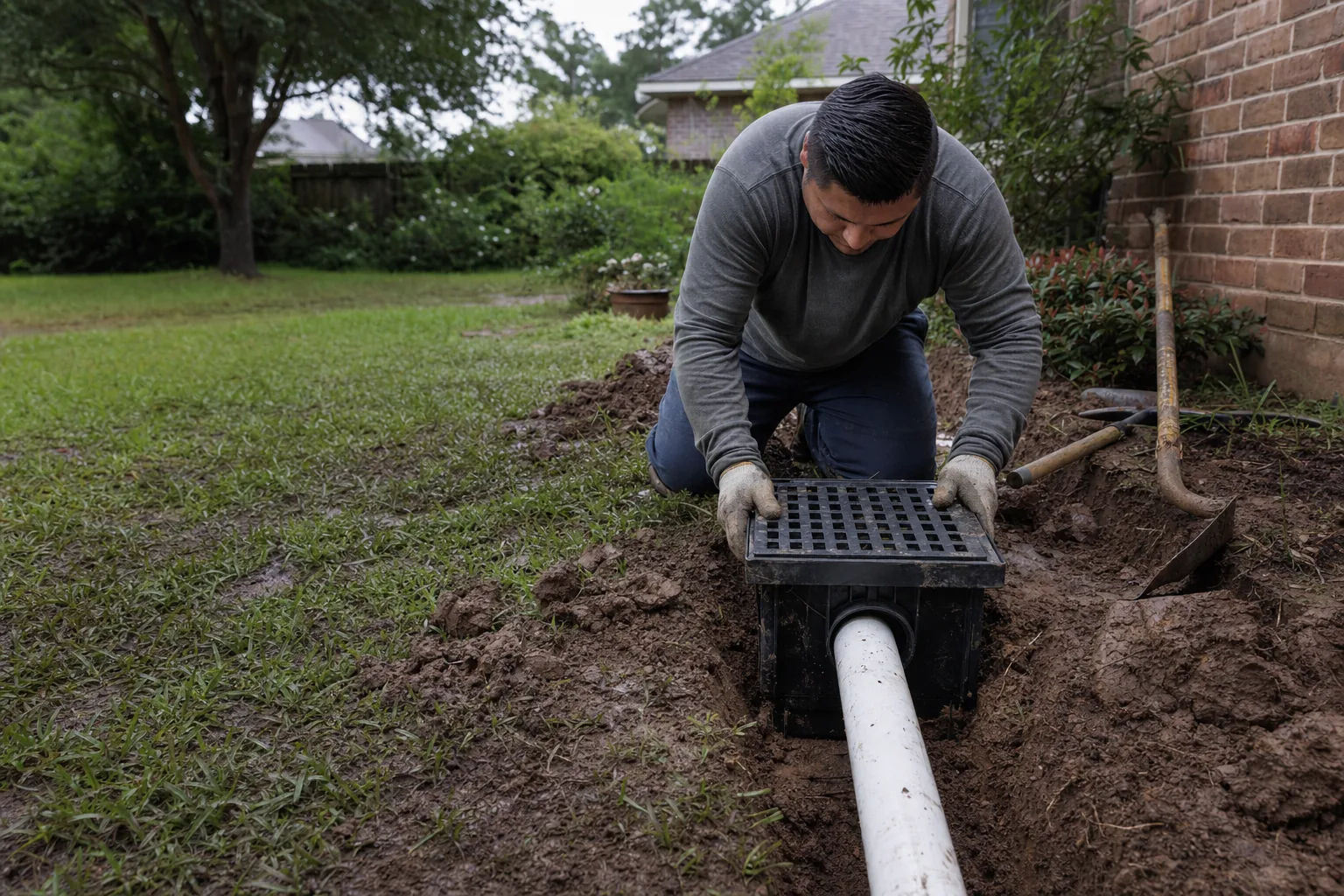
Source control can keep concentrated roof or hard-surface water from entering the problem area. Selective grading can restore a shallow surface route where usable fall exists. A surface inlet can collect water at a repeatable low point and a solid line can convey it. A French drain can receive water moving through saturated soil. Pumps or storage may enter the conversation when gravity cannot provide an acceptable outlet.

The sequence matters. Capturing more water without checking the endpoint can make the outlet fail sooner. Moving a low point without tracing the new route can shift the symptom. Combining several products without assigning each one a job makes the proposal harder to evaluate and maintain.

City guidance generally protects adjacent private property from redirected sheet flow. That is a constraint, not a complete answer for a residential address. Easements, HOA requirements, public right of way, and the proposed discharge point still need address-specific review.

Use regional soil as context, not a verdict

USDA describes the Beaumont soil series found on the Texas Gulf Coast as poorly drained and very slowly permeable on nearly level coastal plains. That helps explain why waiting for water to soak in may be unreliable in some regional settings.

It does not prove that your yard has Beaumont soil, that soil is the only problem, or that a particular drain will work. Fill, construction disturbance, compaction, landscaping, roots, and small grade changes can make neighboring lots behave differently. The actual parcel still has to be observed.

Build a useful rain record

Pick four or five repeatable photo positions before the next rain. A back-door view, each side yard, the main low point, and the proposed outlet are often more useful than twenty closeups of puddles. Take a short set when rain begins, near the peak, when it stops, and later as the yard recovers.

Add a few notes:

  • approximate rain start and stop times;
  • when the low point first filled;
  • whether water was moving or still;
  • how the outlet looked at the same moment;
  • how long the area remained wet;
  • recent changes to gutters, beds, fences, paving, irrigation, or landscaping.

Do not wade into moving water or approach electrical equipment to get a photo. A missing photo is better than an unsafe one.

What a good inspection should return

The useful result is not simply a product name. It is a plain account of the observed source, the failed part of the path, the proposed route, the outlet, known conflicts, and what the work will not solve. If measurements or assumptions control the recommendation, they should be stated.

High & Dry is a referral marketing service. We can connect you with a local drainage contractor for an on-site look. We do not perform construction or promise that a particular approach fits before the property is inspected.

Sources used for this guide: USDA, Official Series Description: Beaumont Series; Texas A&M AgriLife, Building a Plant Bed; and City of Houston, Stormwater Design Requirements. They provide regional and planning context, not a parcel diagnosis.

What happens after you call.

Phone stays first so we can ask where water enters, where it collects, and what has changed on the property.

  1. Call first A real person hears what is staying wet and where the water needs to go.
  2. We review the request High & Dry confirms the location and the drainage symptom.
  3. Contractor evaluates A local drainage contractor checks the grade, soil, and discharge route before defining a scope.

Get a yard drainage solutions quote

Describe the problem so a local drainage contractor can evaluate it after reviewing the property.

Call (346) 478-0205
Project details Share enough detail for us to understand the drainage problem.
By submitting, you agree a local contractor may contact you about your project. Calls may be recorded for quality.

Yard Drainage Solutions questions, answered

What should I check after the next rain?
Trace the sequence from source to route to stopping point to outlet. Take the same few photos at the beginning, peak, end, and recovery instead of photographing only the deepest puddle.
Does Houston clay mean I need a French drain?
No. Regional soil descriptions are context, not a parcel diagnosis. Surface runoff, grades, collection, conveyance, and the available outlet still need to be checked at the property.
Can a drainage project send water toward the next property?
Do not assume so. City guidance generally protects adjacent private property from redirected sheet flow, and the rules, easements, and approvals for a specific route still need confirmation.
Call (346) 478-0205